Magnolia Seamless: A Practical Guide to Floral Vector Patterns
In the vast landscape of digital design assets, finding a pattern that balances aesthetic appeal with technical versatility can be a challenge for creators. The Magnolia Seamless collection addresses this specific need by offering a floral small cute magnolia seamless pattern that bridges the gap between delicate illustration and functional design utility. Whether you are a professional graphic designer working on packaging or a hobbyist creating personalized stationery, understanding the nuances of this vector illustration is essential for achieving high-quality results. This guide explores the practical applications, technical specifications, and creative potential inherent in these files.
Understanding the Aesthetic and Technical Composition
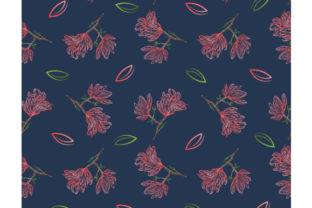
At its core, the Magnolia Seamless pattern is defined by its duality. Visually, it presents a soft, organic motif characterized by small, cute magnolia blooms arranged in a repeating tile. This aesthetic is intentionally designed to evoke feelings of spring, renewal, and gentle sophistication. However, the true value lies beneath the surface in its technical construction. Unlike raster-based patterns that suffer from pixelation when resized, this asset is provided as a vector illustration. This distinction is critical for professionals who require scalability without quality loss.
The package includes two distinct file formats: one vector EPS and one JPG. Understanding the relationship between these files is key to maximizing their usefulness. The JPG serves as an immediate visual reference and is suitable for web-based mockups or low-resolution previews. Conversely, the EPS file contains the mathematical path data that defines the artwork. This allows users to manipulate individual elements, adjust colors, and scale the pattern to fit anything from a business card to a billboard while maintaining crisp edges. The "seamless" designation indicates that the artwork has been mathematically aligned so that when tiled horizontally and vertically, no visible breaks or mismatched lines occur. This precision saves designers hours of manual alignment work.
Evaluating Suitability for Different Projects
Before integrating Magnolia Seamless into a workflow, it is helpful to assess whether its specific characteristics align with project goals. While versatile, no single asset is perfect for every scenario. Consider the following factors when determining suitability:
- Scale Requirements: If your project involves large-format printing such as wallpaper or fabric bolts, the vector EPS format makes this pattern an ideal candidate. For social media graphics where resolution is fixed, the included JPG may suffice.
- Brand Tone: The "small cute" descriptor suggests a playful yet refined tone. This works exceptionally well for baby products, wedding invitations, and boutique branding. It may be less suitable for industrial or hyper-modern tech aesthetics unless used ironically or heavily modified.
- Customization Needs: Because this is a vector illustration, users can easily isolate the magnolia flowers from the background. If your project requires placing these florals onto a colored backdrop rather than using the pre-set arrangement, the EPS file facilitates this extraction effortlessly.
- Color Harmony: Evaluate the existing color palette of the pattern against your brand guidelines. Vectors allow for global color changes, but starting with a base that already complements your scheme reduces editing time.
Real-World Applications and Creative Scenarios
Theoretical knowledge of file types is useful, but seeing how Magnolia Seamless functions in practice provides better insight into its value. Designers across various industries utilize floral seamless patterns to add texture and depth without overwhelming primary content. Below are several practical scenarios where this specific asset excels.
Packaging and Product Labeling
In the consumer goods sector, particularly for cosmetics, teas, and artisanal foods, packaging must communicate quality instantly. The Magnolia Seamless pattern serves as an excellent secondary background element on labels and boxes. Because the motifs are small and repetitive, they provide visual interest without competing with typography or regulatory text. Using the vector EPS ensures that even on small cylindrical labels, the floral details remain sharp during the printing process. Designers often reduce the opacity of the pattern to create a subtle watermark effect, adding a premium feel to otherwise simple packaging.
Textile and Surface Pattern Design
Fabric designers frequently use base patterns as starting points for more complex compositions. The seamless nature of this magnolia illustration makes it ready for direct textile printing. However, experienced designers also use it as a modular component. By extracting individual vector flowers and rearranging them at different scales, one can create entirely new layouts while maintaining stylistic consistency. This approach is valuable for creating coordinated product lines, such as matching duvet covers and pillowcases, where variation is desired within a unified theme.
Digital Stationery and Web Backgrounds
For web designers and digital stationers, file size and load times are practical considerations. While the EPS is necessary for print, the included JPG offers a lightweight solution for digital interfaces. When optimized correctly, this floral pattern can serve as a CSS background for websites or email newsletters. The "cute" and approachable aesthetic helps soften corporate communications or adds warmth to personal blogs. Furthermore, digital planners and printable journals benefit significantly from this asset, as users appreciate high-resolution backgrounds that look good on both screens and printed paper.
Navigating Limitations and Practical Expectations
To maintain a balanced perspective, it is important to discuss the limitations and considerations associated with using stock vector patterns like Magnolia Seamless. Being aware of these factors prevents frustration and ensures realistic project planning.
- Licensing Restrictions: Always verify the specific license terms associated with the download. While the files are yours to use, many licenses prohibit reselling the pattern "as-is" or using it in products where the pattern itself is the primary value proposition. Understanding these boundaries protects your business legally.
- Software Compatibility: The EPS format is widely supported, but compatibility can vary between software versions. Users of older Adobe Illustrator versions or alternative vector software like Affinity Designer should test the file immediately upon acquisition. Occasionally, gradient meshes or complex transparencies in vectors may require expansion or simplification to render correctly across different platforms.
- Overuse and Saturation: Popular floral patterns can become ubiquitous. To avoid generic results, consider how to make the Magnolia Seamless pattern unique to your project. This might involve applying custom texture overlays, blending modes, or combining it with hand-drawn elements to create a proprietary look.
- Print Color Variance: What you see on an RGB monitor differs from CMYK print output. Floral patterns, especially those with soft pastels common in magnolia illustrations, can shift during printing. Always request physical proofs or use calibrated color profiles when preparing the vector file for commercial production.
Technical Best Practices for Implementation
Maximizing the utility of the included vector EPS and JPG files requires adherence to certain technical best practices. When working with the EPS, keep your layers organized. Separate the background from the foreground floral elements to allow for non-destructive editing. If you plan to change colors, use global swatches whenever possible; this allows you to update the entire pattern’s color scheme with a single click rather than selecting individual paths manually.
For those utilizing the JPG for digital purposes, ensure you are not upscaling the image beyond its native resolution. Upscaling raster images introduces artifacts that undermine the clean aesthetic of the original vector art. If a larger size is needed, return to the EPS source file and export a new raster version at the required dimensions. Additionally, when tiling the pattern in web design, use CSS properties like background-repeat efficiently to ensure smooth rendering across different viewport sizes without causing layout shifts.
Making Informed Decisions for Your Creative Library
Building a reliable library of design assets is an investment in efficiency and quality. The Magnolia Seamless collection represents a specific niche within that library: the intersection of botanical charm and vector precision. Its inclusion of both EPS and JPG formats demonstrates an understanding of diverse user needs, catering to both high-end print production and quick digital deployment.
Ultimately, the decision to utilize this floral small cute magnolia seamless pattern should be driven by project requirements rather than trend alone. Ask yourself if the scale of the motifs fits your canvas, if the vector format justifies the file management overhead, and if the aesthetic resonates with your target audience. When these elements align, Magnolia Seamless transitions from a simple download to a foundational tool that enhances creativity and streamlines production workflows. By approaching this asset with a clear understanding of its strengths, limitations, and technical capabilities, creators can unlock its full potential and produce work that stands out for both its beauty and its professional execution.