Implementing the Outline Dahlia Flowers Pattern in Textile and Apparel Design
The outline dahlia flowers pattern represents a specific intersection of botanical illustration and modern surface design, characterized by linear definition rather than solid fills. In professional textile and apparel workflows, this aesthetic serves as a versatile foundation that bridges traditional artistry with contemporary manufacturing requirements. Unlike fully rendered florals, the outline approach relies on negative space and stroke weight to define form, making it uniquely adaptable for various production methods ranging from digital printing to embroidery. When integrated into a broader creative process, this pattern type functions not merely as decoration but as a structural element that dictates color separation, fabric selection, and end-use application.
For designers and product developers, understanding the technical nuances of outline dahlias is essential before moving to production. The pattern’s success depends heavily on line integrity and contrast ratios, particularly when applied to complex substrates like bed linen or women's clothing. Treating the outline dahlia flowers pattern as a modular asset within your design system allows for greater flexibility across different product categories while maintaining brand consistency.
Technical Preparation and Asset Management
Before applying an outline dahlia flowers pattern to any physical medium, rigorous digital preparation is required. The workflow begins with vectorization or high-resolution raster cleanup to ensure lines remain crisp at all scales. For home textiles like curtains and pillows, where repeat sizes can be large, maintaining a minimum line thickness relative to the print scale is critical to prevent breakage during washing or wear.
- Vector Integrity: Ensure all anchor points are optimized. Jagged curves in outline work become glaringly obvious on fabric. Use smoothing tools judiciously to retain the organic feel of the dahlia without introducing mechanical rigidity.
- Color Separation Strategy: Even if the final output is full-color digital print, separating the outline layer from the background allows for future adaptability. This enables quick recoloring for seasonal collections without redrawing the floral elements.
- Repeat Logic: Test the pattern tile at 50%, 100%, and 150% zoom levels. Outline patterns often reveal alignment errors in half-drops or brick repeats that solid patterns hide. Verify that stem connections flow naturally across seam lines.
This preparation phase directly impacts downstream efficiency. A well-structured master file reduces revision cycles with printers and minimizes sampling costs. For entrepreneurs managing small batches, investing time in asset organization pays dividends when adapting the same outline dahlia motif for both a duvet cover and a blouse collar.
Integrating Watercolor Elements with Linear Structure
Combining watercolor textures with outline dahlia flowers introduces complexity regarding registration and color bleeding. In a practical workflow, these two elements should often be treated as separate layers that interact visually but remain technically distinct. This separation provides control over opacity and blending modes during the proofing stage.
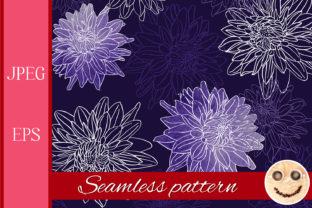
When designing for dark purple backgrounds, the interaction between the translucent watercolor washes and the opaque outline requires careful calibration. Standard CMYK proofs on white paper will not accurately represent how light watercolors behave on deep violet fabric. Professionals must utilize calibrated soft-proofing profiles specific to the target substrate or invest in strike-offs on the actual base cloth early in the development cycle. The outline acts as a containment field for the watercolor; ensuring the stroke weight is sufficient to visually anchor the softer painted areas prevents the design from appearing muddy or undefined against the dark ground.
Consider the drying and curing processes of your chosen printing method. Reactive dyes on cotton may cause slight spreading, which can soften the interface between the outline and the watercolor fill. Digital pigment printing offers sharper edges but may sit differently on the fabric hand. Aligning your artistic intent with the mechanical realities of the print technology ensures the final product matches the digital vision.
Application-Specific Workflow Considerations
The versatility of the outline dahlia flowers pattern lies in its scalability, but successful implementation requires adjusting parameters based on the end product. What works for stationary bedding may fail on draped apparel due to differences in grainline and movement.
Home Textiles: Bed Linen and Curtains
For large-format home goods, the pattern repeat should generally be larger to avoid visual fatigue. When placing outline dahlias on bed linen, consider the "pillow tuck" and fold lines. Key motifs should be positioned so they remain visible when the bed is made, avoiding placement solely in areas that will be permanently tucked or obscured by pillows. For curtains, account for stack-back and pleating. Test the pattern on a vertical mockup to ensure the dahlia stems do not appear distorted when the fabric gathers. Dark purple bases absorb light, so ensure the outline contrast meets visibility standards for interior lighting conditions.
Apparel and Women’s Clothing
Clothing introduces the variable of body curvature and garment construction. Scale down the outline dahlia flowers pattern significantly for apparel to maintain proportion with the wearer. Placement becomes paramount; avoid positioning prominent floral outlines directly across bust points or hip curves unless intentional distortion is desired. For women’s clothing, test the pattern on bias-cut versus straight-grain sections. Outline work can look skewed on the bias if the underlying geometry isn't adjusted. Additionally, consider seam allowances. Matching outline patterns across side seams elevates perceived quality but increases fabric waste and cutting time. Decide early whether pattern matching is a non-negotiable quality standard or if a mismatched seam is acceptable for cost efficiency.
Quality Control and Production Compatibility
Integrating this pattern into a commercial workflow necessitates robust quality checkpoints. Outline designs are less forgiving of registration errors than painterly florals. Establish tolerance thresholds for line wobble and color misalignment before approving bulk production.
- Strike-off Evaluation: Always request a strike-off on the exact base fabric (dark purple) rather than a substitute. Evaluate under D65 daylight simulators to verify that the outline maintains adequate contrast against the purple and that watercolor hues haven't shifted toward muddiness.
- Wash Fastness Testing: Outline prints, especially those using discharge or resist techniques on dark grounds, can degrade differently than solid colors. Conduct accelerated laundering tests to ensure the fine lines do not crack or fade prematurely compared to the background.
- Hand Feel Assessment: On dark purple fabrics, achieving vibrant outlines sometimes requires heavier ink deposits. Verify that the printed area does not create an undesirable stiff panel, particularly for pillows and clothing where tactile comfort is primary.
Compatibility extends beyond physical properties to software ecosystems. Ensure your pattern files are compatible with the RIP software used by your manufacturer. Some older systems struggle with complex transparency effects common in watercolor-outline hybrids. Flattening transparencies or converting specific blend modes to spot colors may be necessary to preserve fidelity. Document these technical specifications alongside your design assets to streamline reorders and future collaborations.
Strategic Value in Product Development
Beyond aesthetics, the outline dahlia flowers pattern offers strategic advantages in inventory and collection planning. Because the design relies on structure rather than dense color saturation, it transitions more easily between seasons. A dark purple base with gold or cream outlines reads as autumnal or winter-appropriate, while swapping the outline color to mint or blush instantly repositions the same asset for spring. This modularity supports leaner SKU management for small business owners and freelancers who need to maximize output with limited resources.
Furthermore, this style aligns with current consumer preferences for "quiet luxury" and artisanal authenticity. The visible line work suggests hand-drawn origin, adding perceived value to mass-produced textiles. For marketers and educators teaching surface design, this pattern serves as an excellent case study in balancing artistic expression with technical constraint. It demonstrates how negative space can be as active and valuable as positive form.
Ultimately, successful integration of the outline dahlia flowers pattern requires viewing it through a lens of process rather than just product. By front-loading technical validation, respecting substrate limitations, and planning for cross-category adaptation, creators can transform a beautiful motif into a reliable, scalable asset. Whether developing a signature bedding line or a capsule clothing collection, the discipline applied to this specific pattern type establishes best practices that elevate the entire design workflow. The result is a cohesive, high-quality offering where the artistry of the dahlia enhances, rather than complicates, the functional reality of the textile.